Published August 22, 2026 · Updated September 19, 2026
In short: Selecting crimping equipment comes down to three variables: the terminal and wire sizes you process, your required volume, and how much verification the end application demands. Low-volume prototyping works with a pneumatic or servo press and changeable applicators. High-mix production needs a semi-automatic or automatic line with crimp-force monitoring. Both approaches still require two proofs: pull-out testing against a minimum force and cross-section analysis showing full compression with no nicked strands.
粘贴进模板; 替换为真实设备/缺陷截面照片 - 作者块替换为具名工程师 -->How to Choose Wire Harness Crimping Equipment
Selecting wire harness crimping equipment comes down to matching the machine's capability to three variables: the terminal and wire specifications you process, your required production volume, and the level of crimp quality verification your end application demands. For low-volume prototyping, a pneumatic or servo crimping press with interchangeable applicators is usually sufficient. For high-volume, high-mix connector production, a semi-automatic or fully automatic wire processing line with integrated crimp-force monitoring provides the consistency and traceability that automotive, medical, and industrial customers typically require.
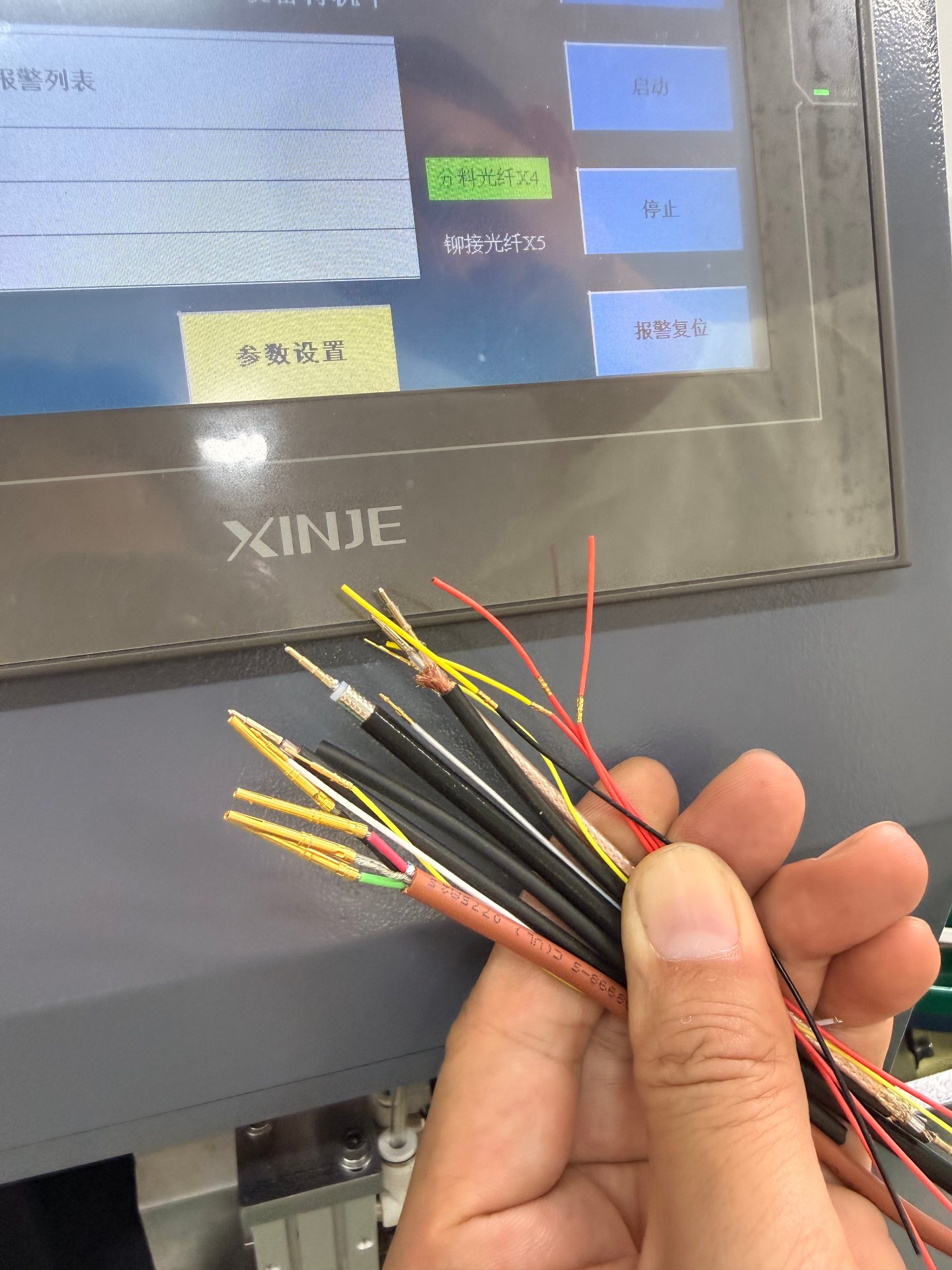
What Is Wire Harness Crimping?
Wire harness crimping is the process of permanently joining a terminal (contact) to the stripped end of a wire by deforming the terminal's barrel around the conductor using a calibrated crimping die and controlled force. The resulting cold-pressed connection relies on metal-to-metal contact and mechanical interlock rather than solder, which makes it faster, lower in weight, and more resistant to vibration than soldered joints when executed correctly.
A proper crimp must satisfy two measurable requirements:
- Mechanical strength — verified by pull-out (tensile) testing against a minimum force threshold.
- Electrical performance — verified by crimp cross-section analysis, which confirms full conductor compression without strand nicking or voids.
Types of Crimping Equipment
| Type | Drive | Typical use | Crimp force control |
|---|---|---|---|
| Hand crimp tools | Manual | Field service, low volume | None (operator-dependent) |
| Pneumatic presses | Air cylinder | Bench work, moderate volume | Fixed pressure, no feedback |
| Hydraulic presses | Hydraulic pump | Large terminals, battery cables | Fixed pressure |
| Servo-electric presses | Servo motor | Quality-critical production | Programmable force + monitoring |
| Semi-automatic machines | Servo + feed | Cut-strip-crimp, mid/high volume | Integrated CFM |
| Fully automatic lines | Servo + robotics | High-volume harness/connector | Full CFM + traceability |
7 Factors to Consider When Selecting Crimping Equipment
1. Wire and Terminal Specifications
Confirm the machine covers your full range of wire gauges (AWG/mm²) and terminal types (open barrel, closed barrel, flag, ferrule, twist-pin/coil-pin contacts). Mismatched applicators are the most common cause of scrap. If you process micro-terminals or fine-pitch connector contacts, verify the press resolution and die registration tolerance.
2. Production Volume and Cycle Time
Estimate parts per shift, not just peak demand. A pneumatic bench press handling 300 crimps/hour will bottleneck a line running 5,000 connectors/day. Semi-automatic cut-strip-crimp machines typically reach 3,000–6,000 terminations/hour depending on wire length and feed complexity. Lanneas LP-MC2024 twist-pin crimper is rated up to 1200 pcs/h on micro-rectangular contacts.
3. Crimp Force Monitoring (CFM)
CFM records the force-displacement curve of every crimp and rejects out-of-tolerance cycles (for example, missing terminal, partial feed, or worn die). For automotive and medical harnesses, CFM is often a contractual requirement. Prioritize presses that store force curves per serial number for audit.
4. Changeover Flexibility
High-mix production benefits from quick-change applicators and stored recipe parameters (crimp height, force window, feed settings). Recipe management reduces setup error and downtime between jobs.
5. Process Validation and Traceability
If you supply regulated industries, the equipment should export crimp data (force curves, counts, timestamps) to MES or a local database. This supports first-article inspection and downstream failure analysis.
6. Operator Skill and Safety
Guarded presses with two-hand or light-curtain activation reduce pinch risk. Consider ergonomics for repetitive tasks and whether the operation needs a skilled technician or can be run by line operators after brief training.
7. Total Cost of Ownership
Look beyond the purchase price: applicator cost per terminal family, die wear life, maintenance intervals, spare-part lead time, and scrap rate. A slightly higher upfront investment in a monitored servo press often pays back through lower scrap and rework.
Common Crimp Defects and How Equipment Choice Prevents Them
| Defect | Cause | Prevention via equipment |
|---|---|---|
| Incomplete crimp | Insufficient force / wrong die | Servo press with force window + CFM |
| Bell mouth | Over-crimp / misaligned die | Calibrated applicator, periodic die check |
| Strand nicking | Sharp die edges, wrong height | Controlled crimp height, cross-section QA |
| Insulation in conductor crimp | Wrong strip length | Integrated cut-strip with length check |
| Lifted / bent terminal | Feed misalignment | Servo terminal feed with position verification |
Relevant Standards
Crimp quality is typically judged against:
- IPC/WHMA-A-620 — the accepted workmanship standard for cable and wire harness assemblies, including crimp height and pull-force acceptance criteria.
- IEC 60352 — solderless connections, including crimped connections.
- USCAR-21 / USCAR-38 — automotive-specific crimp performance and test requirements.
Align your equipment's verification capability (pull testing, cross-section analysis, CFM) with the standard your customer specifies.
Manual vs. Semi-Automatic vs. Fully Automatic
- Manual / pneumatic: Low capital cost, flexible for prototypes and repair. Limited consistency, no data.
- Semi-automatic: Balances throughput and control; suitable for batches of 1k–50k with recipe changeovers.
- Fully automatic lines: Highest throughput and traceability; justified when volume and quality documentation requirements are high (for example, automotive connector lines and automated assembly cells).
For manufacturers building connector sub-assemblies at scale, integrating crimping into an automated assembly line — combining terminal crimping, pin insertion, and welding stations — reduces handling and improves first-pass yield.
Frequently Asked Questions
- What crimp height tolerance is acceptable?
- It depends on the terminal specification from the original terminal manufacturer, typically expressed as a nominal value with a ± tolerance (commonly ±0.05 mm to ±0.10 mm). Always use the terminal maker's recommended crimp height, not a generic value.
- How often should crimping dies be inspected?
- Most production lines perform a visual and dimensional check at setup (first-article) and scheduled maintenance per cycle count or calendar interval. Crimp cross-section analysis is recommended after any die change or when CFM trends shift.
- What is crimp force monitoring and do I need it?
- CFM measures the force required to close each crimp and compares it to an approved reference curve. It detects missing terminals, incorrect feeds, and worn tooling in real time. If you supply automotive, medical, or aerospace harnesses, plan for it from the start.
- Can one machine handle different terminal families?
- Yes, with quick-change applicators and stored recipes. Confirm the press accepts the applicator standard your terminal suppliers use and that changeover time fits your batch sizes.
- What type of crimping machine do I need for wire harness production?
- It depends on volume and wire type: benchtop crimpers for low volume, rotary/terminal machines for high volume, and twist-pin or coax-specific machines for micro-rectangular and RF connectors.
Conclusion
Choosing wire harness crimping equipment is less about finding the most powerful press and more about matching capability to your wire/terminal range, volume, and quality documentation needs. Start by defining your crimp specifications and the standards your customers require, then select a platform — from pneumatic bench press to fully automated line — that can verify and record every crimp.
How to Choose Wire Harness Crimping Equipment | Guide — FAQ
What are the two tests a good crimp must pass?+
When does crimp-force monitoring pay for itself?+
Should I buy semi-automatic or fully automatic equipment?+
Which defects should the machine prevent rather than detect?+
Which standards should the equipment support?+
Related reading
Automotive Crimp Standards Compared: QC/T 29106 vs USCAR21
QC/T 29106 judges quality from a polished cross-section: conductor strands evenly distributed, no broken wires, no defor
Complete Guide to Wire Harness Crimping Equipment Resources
Types, working principles, key parameters and buying advice for wire harness crimping machines.
Manual vs Automatic Connector Assembly: Cost & Quality Comparison
Should you keep crimping by hand or move to automated cells? This side-by-side compares labor, defect rates and traceabi
Crimping Machines | Wire Harness Equipment
Lanneas crimping machines deliver consistent pull-off force, 99%+ yield and stable high-speed production for terminals,