
Standard machines and custom turnkey lines for crimping, testing, welding and automated assembly of micro-rectangular, RF and military-grade connectors.
Twist-pin crimpers, fine-wire crimping and dual-wire parallel presses with servo + force-sensor control.
J30J wire-sequence testers and pin-retention testers that stop defects at the source.
Center-pin welders for RG58, SMA and 178 antennas with precise solder control.
SMA/SMB antenna assembly cells and custom turnkey harness lines.
Automatic Assembly Machines | Wire Harness Equipment in one sentence: This is the automatic assembly family: cells that carry a harness from wire feeding and stripping through crimping, welding, high-voltage testing and heat-shrink packaging. It suits antenna and wire harness makers replacing manual stations, where the gain is steady output and quality that does not move with shift or operator.
From wire feeding and stripping to crimping, welding, high-voltage testing and heat-shrink packaging, our automatic assembly lines help antenna and wire harness manufacturers replace manual labor and stabilize mass-production quality.
A standard cell assumes your part sits inside the tooling envelope already built. Unusual connector geometry, very long harnesses or a process step outside the standard set turn it into a custom build, with design time added before delivery. Very low volumes rarely pay back the changeover.
| Parameter | Value | Unit | Test condition |
|---|---|---|---|
| Process coverage | Feeding, stripping, crimping, welding, testing, packaging | set | Stations selected per project |
| Automation level | Automatic with manual loading | set | Higher levels on request |
| Inline testing | High-voltage and continuity | set | Station added where the standard requires it |
| Traceability | MES-ready production data | set | Interface configured at commissioning |
| Configuration | Standard base or custom layout | set | Decided from part and throughput target |
| Typical sectors | Telecom, automotive, radar | set | Antenna and harness production |
| Model | Key specifications | Positioning |
|---|---|---|
| ANT-15 | 15 stations, 500-600 pcs/h, one operator | Antenna families in the 174 / SMA / SMB / GPS range |
| Standard cell | Existing stations rearranged to your process | When your part fits the tooling already built |
| Custom cell | New station design for the part | When geometry or process step is outside the standard set |
| MOQ | 1 set | ||
|---|---|---|---|
| Lead time | Confirmed per order, depends on configuration | ||
| Availability | InStock | ||
| Quote terms | Written quotation within 24 working hours | ||
| Certifications | CE,FDA | ||
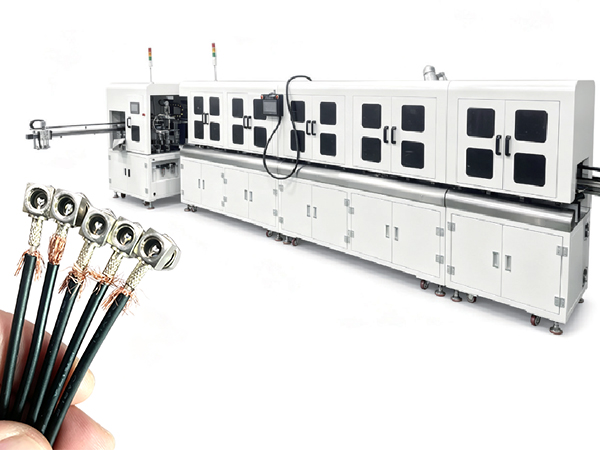
An automated assembly machine for 174-line, SMA/SMB/GPS connector antennas, built for antenna manufacturers. It solves t

Lanneas crimping machines deliver consistent pull-off force, 99%+ yield and stable high-speed production for terminals,

When a standard machine cannot fit your part, Lanneas designs and builds custom wire harness equipment around your produ
Send us your connector type, target throughput and quality standard. Our engineers recommend the right machine or line within one business day.
Request a Quote →