
Standard machines and custom turnkey lines for crimping, testing, welding and automated assembly of micro-rectangular, RF and military-grade connectors.
Twist-pin crimpers, fine-wire crimping and dual-wire parallel presses with servo + force-sensor control.
J30J wire-sequence testers and pin-retention testers that stop defects at the source.
Center-pin welders for RG58, SMA and 178 antennas with precise solder control.
SMA/SMB antenna assembly cells and custom turnkey harness lines.
Welding Machines | Wire Harness Equipment in one sentence: The welding range puts automatic tin feeding, pin insertion and soldering into one controlled process. It addresses the three failures of hand soldering on RF work: uneven solder volume, yield that varies by operator, and a cycle time that sets the pace of the whole line.
Our welding machines integrate automatic tin feeding, pin insertion and soldering into one controlled process, solving uneven tin volume, low yield and slow manual soldering in RF antenna and coaxial cable production.
Soldering is only as consistent as the parts fed to it, so cable strip length and pin condition must be controlled upstream. Leaded and lead-free profiles need different parameters, and very large cable sizes fall outside the standard heating and feeding envelope.
| Parameter | Value | Unit | Test condition |
|---|---|---|---|
| Process steps | Tin feeding, pin insertion, soldering | Integrated in one controlled cycle | |
| Cable types | RG58, SMA, 178 | Tooling set confirmed at order | |
| Temperature control | Closed-loop profile | Profile stored per part | |
| Solder volume | Controlled, repeatable | Across the production run | |
| Cycle logging | Per cycle | Parameters captured for traceability | |
| Operation | Automatic | Manual load, automatic cycle |
| Model | Key specifications | Positioning |
|---|---|---|
| LP-CW2060 | Closed-loop temperature, RG58 / SMA / 178 | Center-pin soldering as a dedicated station |
| ANT-15 | 15 stations, 500-600 pcs/h, one operator | When soldering is one step of a full antenna cell |
| Custom cell | New station for the part | Cable or pin geometry outside the standard envelope |
| MOQ | 1 set | ||
|---|---|---|---|
| Lead time | Confirmed per order, depends on configuration | ||
| Availability | InStock | ||
| Quote terms | Written quotation within 24 working hours | ||
| Certifications | CE | ||
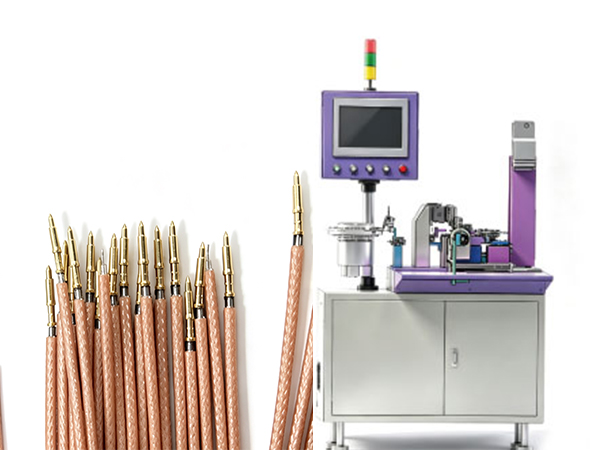
An automatic soldering machine for RG58, SMA and 178 antenna makers. It solves the core problems of unstable solder volu
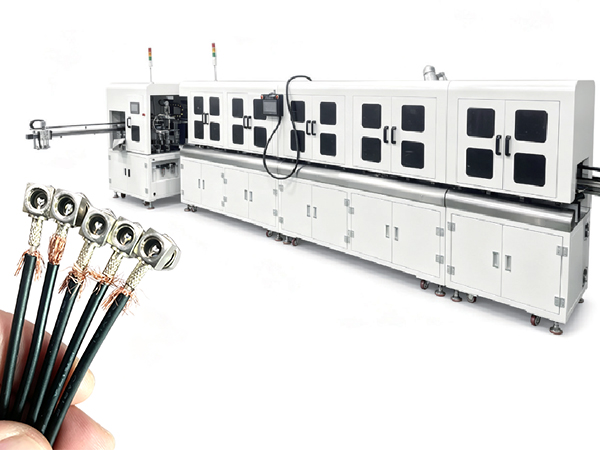
An automated assembly machine for 174-line, SMA/SMB/GPS connector antennas, built for antenna manufacturers. It solves t

From wire feeding and stripping to crimping, welding, high-voltage testing and heat-shrink packaging, our automatic asse
Send us your connector type, target throughput and quality standard. Our engineers recommend the right machine or line within one business day.
Request a Quote →